

Wear-resistant steel is commonly used in construction machinery, mining equipment and shipbuilding industries. Hardox-500 is a widely used high-strength wear-resistant steel. It has matching equivalent grades in different countries, including Chinese NM500, American AR500 and Russian 500HB. This steel features high hardness and high strength, which brings great difficulty to traditional cutting processing. Traditional machining methods easily cause thermal deformation, surface defects and material performance loss. This paper introduces the basic characteristics and application scenarios of Hardox-500 and its equivalent steel grades. It analyzes the defects of conventional processing technologies, summarizes the research results of waterjet cutting on Hardox-500, and discusses the quality and economic advantages of this processing method. This paper can provide simple and practical guidance for actual production and parameter selection.
1. Basic Information of Hardox-500 and Its Equivalent Grades
1.1 Steel Grades and Corresponding Standards
Hardox-500 is originally produced by Sweden SSAB. Many countries have developed similar wear-resistant steel grades according to local industrial standards. The mainstream equivalent grades and relevant standards are listed below.
| Classification | Steel Grade | Implementation Standard |
| International Original Grade | Hardox-500 | SSAB Enterprise Standard, Sweden |
| Chinese Domestic Equivalent Grade | NM500 | GB/T 24186-2022 |
| North American Common Grade | AR500 | ASTM A1011 / ASTM A1018 |
| Russian Equivalent Grade | 500HB | GOST 19281-2017 |
1.2 Main Mechanical Properties
Hardox-500 is a low-alloy quenched and tempered wear-resistant steel. Its main performance characteristics are listed below:
- Hardness: The standard hardness is 500 HBW, and the actual hardness of finished steel plates is between 470 HBW and 530 HBW.
- Strength and toughness: The yield strength is 1250 to 1400 MPa. It keeps good toughness at normal temperature and low temperature.
- Processing performance: The steel plate can be bent, welded and processed with other mechanical methods.
- Specification range: The available thickness covers 2 mm to 103 mm. It is suitable for thin plate parts and heavy thick plate wear components in actual production.
1.3 Typical Application Fields
Hardox-500, NM500, AR500 and Russian 500HB steels have good wear resistance and structural stability. They are widely used in industrial equipment. Common products include excavator buckets, dump truck boxes, mining chutes, storage silos, ship wear decks, cement mixing blades and solid waste crushing parts. These components work under heavy friction and impact. They require high-standard processing quality and stable surface performance.
2. Common Machining Methods for Hardox-500 and Their Defects
2.1 Flame Cutting
Flame cutting costs little and operates easily. It is usually used for rough cutting of thick steel plates. However, high temperature produces obvious heat-affected zones. It reduces surface hardness and causes local brittleness. The steel plate is easy to deform. The cutting surface has much slag and burrs. Workers need repeated grinding and finishing.
2.2 Plasma Cutting
Plasma cutting is fast and efficient. It fits batch processing of medium and thin steel plates. But this method also brings thermal damage. Micro cracks often appear on the cutting surface. It destroys the original wear resistance and mechanical properties of Hardox-500 steel. Thus, it is not suitable for high-precision and high-reliability parts.
2.3 Laser Cutting
Laser cutting achieves high precision for thin plates. But it has limited capacity for plates thicker than 20 mm. Cutting stability drops greatly. Small thermal deformation is unavoidable. The equipment purchase and maintenance cost is high. It is not economical for mass processing of thick wear-resistant steel plates.
2.4 Traditional Mechanical Cutting
Milling and sawing cause no thermal damage. But they lead to severe tool wear when cutting high-hardness Hardox-500 steel. The processing speed is slow and the production cost is high. It is difficult to machine complex shaped parts. It cannot meet diverse processing needs of engineering components.
3. Research Results of Waterjet Cutting on Hardox-500
All test data, process parameters and conclusions in this paper come from the joint research of Professor Sylvio Simon’s team at Brandenburg University of Technology Cottbus-Senftenburg and Azerbaijan Technical University.
3.1 Basic Test Process Parameters (Ref. [3][4])
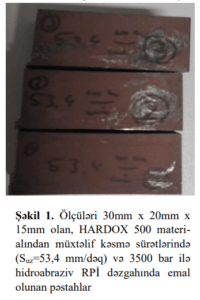
This test used abrasive waterjet cutting machine. All test parameters are sorted in detail as follows:
- Working water pressure: 2500 bar to 3500 bar
- Abrasive material: 80-mesh garnet
- Abrasive mixing ratio: 85 grams per liter of water
- Test steel plate thickness: 5 mm, 10 mm and 15 mm
- Test feed speed: 53.4 mm/min, 77.4 mm/min, 152 mm/min, 228 mm/min, 301 mm/min, 380 mm/min
3.2 Cutting Accuracy and Section Morphology (Ref. [1][3])
Feed speed directly affects the verticality and quality of cutting sections. For 15 mm thick Hardox-500 steel, the section keeps the best verticality at 53.4 mm/min. Thicker steel plates cause more obvious waterjet energy loss. High feed speed easily produces water ripples and dimensional errors on the cutting surface. As a cold processing method, waterjet cutting will not cause deformation or size change of workpieces.
3.3 Surface Roughness Performance (Ref. [1])
Under the same processing conditions, surface roughness Ra increases with the growth of plate thickness. For 15 mm thick steel cut at low speed, the minimum Ra value of the stable central area is 3.1 μm. The maximum profile height Rz rises as feed speed increases. The middle thickness area of the steel plate has the most stable cutting state. It is the best area for surface quality inspection.
3.4 Surface Microhardness Improvement (Ref. [2])
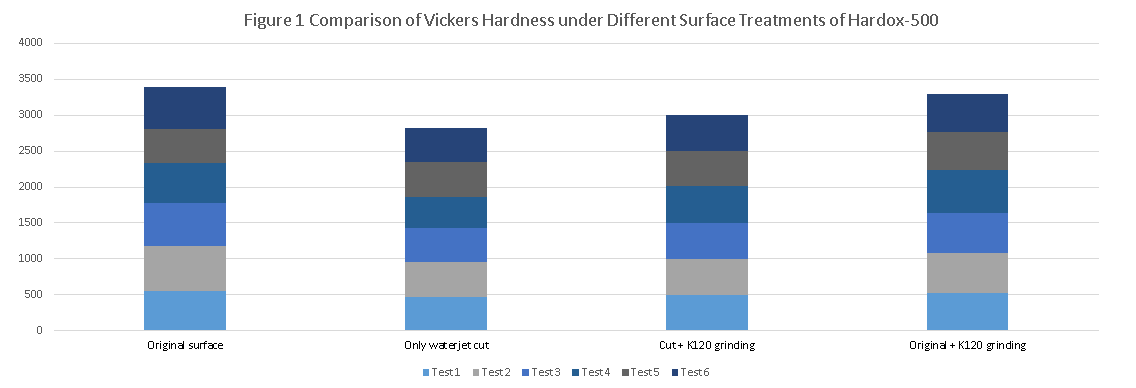
The original Vickers hardness of Hardox-500 base material is 441~490 HV60. During waterjet cutting, high-speed abrasive impact causes work hardening on the cutting surface. The surface microhardness rises to 475~625 HV60, with an increase of 34~135 HV60. After water-cooling grinding with K120 wheel, the hardened layer remains stable without hardness drop. It greatly improves the surface wear resistance of processed parts.
3.5 Chip Formation and Abrasive Wear Rule (Ref. [4])
Test results show that garnet particles break and become blunt after hitting the steel surface. Under standard working conditions, 425 to 482 abrasive particles take part in cutting every second. The study establishes vertical and inclined waterjet impact models. The cutting force is divided into three types: tangential separation force, axial compression force and chip removal force. It clearly explains the material removal mechanism of waterjet cutting for Hardox-500 steel.
4. Practical Advantages of Waterjet Cutting
4.1 Quality Advantages
First, waterjet cutting is a pure cold processing technology. It has no heat-affected zone, no oxide layer and no micro cracks. It fully retains the original mechanical properties and wear resistance of Hardox-500, NM500, AR500 and Russian 500HB steel. Second, the cutting surface has no burrs or slag. It achieves high one-time forming accuracy and supports integral processing of special-shaped wear plates and ship parts. Third, abrasive impact forms a stable hardened layer on the surface. It improves surface hardness and wear resistance, and extends the service life of engineering components.
4.2 Economic and Production Advantages
Waterjet cutting has a narrow cutting slit. It improves steel plate utilization by 10%~15% and reduces waste of high-cost wear-resistant steel. It simplifies production procedures. It removes secondary processes such as leveling, stress relief and manual grinding. The whole production cycle is shortened by over 30%, and post-processing cost is greatly reduced. Waterjet equipment has strong universality. It can process different materials without frequent tool replacement. It meets the diversified production needs of processing factories. Stable processing quality reduces later maintenance and part replacement frequency, and lowers the full-cycle use cost.
4.3 On-site Application Advantages
Waterjet cutting produces no open flame and no spark. It meets fire prevention and explosion-proof requirements for ship repair, underground mining and chemical construction sites. The processing process is low-noise and environmentally friendly. Cutting water can be filtered and recycled. It fully meets the green production standards of modern industry.
5. Practical Processing Suggestions
Based on the test data of Simon’s research team (Ref. [1][2][3]), for common 15 mm thick Hardox-500, NM500, AR500 and Russian 500HB steel plates, the recommended parameters are 2500~3500 bar water pressure and 53.4~77.4 mm/min low feed speed. This parameter combination ensures high dimensional accuracy, low surface roughness and good surface hardness. For 5~10 mm thin plates, feed speed can be increased properly to balance processing efficiency and surface quality. For projects requiring complete material performance retention, high-precision blanking, fire-safe operation and thick-plate fine processing, waterjet cutting is the best substitute for traditional thermal cutting and mechanical cutting. It is currently the most reliable fine processing solution for Hardox-500 series and its equivalent wear-resistant steel.
References
[1] Sylvio Simon, Yusubov N.D., Amirli S.F. Hydroabrasive Machining Application in Shipbuilding[J]. Proceedings of Azerbaijan State Marine Academy, 2024(1):48-51.
[2] Sylvio Simon, Yusubov N.D., Amirli S.F. Investigation of Microhardness of Parts Cut from Hardox-500 Material under Different Cutting Modes[J]. Scientific Works of Azerbaijan State Marine Academy, 2024.
[3] Sylvio Simon. Waterjet Cutting of Hardox-500 Workpiece[R]. Joint Research Report, Brandenburg University of Technology Cottbus-Senftenburg & Azerbaijan Technical University, 2024.
[4] Sylvio Simon, Yusubov N.D., Amirli S.F. Research on Chip Formation Characteristics in Abrasive Waterjet Machining[R]. Metal Cutting Machine Tool Joint Laboratory, 2024.
[5] National Standard of China GB/T 24186-2022, High Strength Wear-resistant Steel Plates for Construction Machinery[S].
[6] American Standard ASTM A1011/A1018, General Specification for AR500 Wear-resistant Steel Plates[S].