

How do you increase effect of waterjet cutting green sandstone ? What We Really Learned from Dry–Wet Cycle Testing?
1. First, what are we actually cutting this stone for?
Green sandstone is very common in coal mines, tunnels, and all kinds of underground construction work, we have to deal with it almost every time in deep underground projects. In theory, it is hard rock, but on real jobsite, it is never just “hard” or “not hard”. The underground environment always change, groundwater go up and down, some places stay in water for very long time, some areas get wet and dry again and again for many months and years. After such long time, the rock inside become bad little by little. It have small cracks, become loose, even look good outside but already weak inside. That’s why when we use abrasive waterjet cutting, we always feel strange: same machine, same parameters, but cutting result is very different. At first, many workers and engineers think it’s machine problem, but actually, most time it’s the rock condition that make the difference.
2. What this experiment really did
Qinglin Deng and his team do a test to check how waterjet cut green sandstone in different condition. They want to find out: if we treat rock with dry and wet many times, will waterjet cut much better.
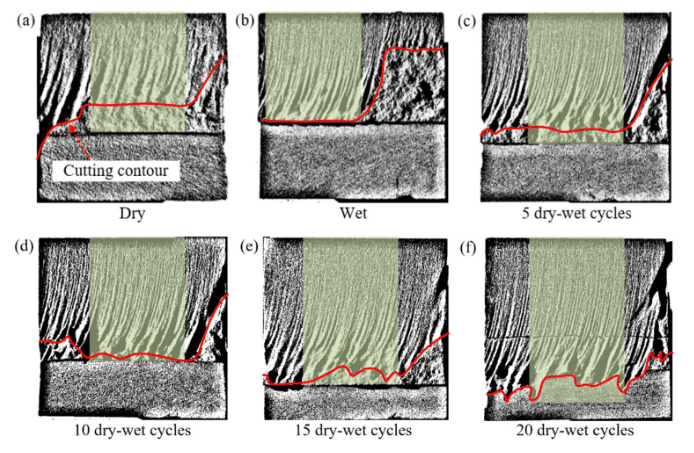
In test, they dry rock in 60°C vacuum until weight no change, then soak rock full in vacuum. They do dry and soak again and again to copy real dry-wet cycle, one dry plus one wet is one cycle. They test 0, 5, 10, 15, 20 cycles, so we can see different rock condition.
In whole test, waterjet parameters all same, fair to compare: pressure 100 MPa, cutting speed 100 mm/min, standoff 5 mm, nozzle 0.335 mm, use garnet abrasive. So machine don’t change, only rock condition is different.
Result show when cycles more, rock get weaker, and cutting efficiency go up very much, not a little. Just wet rock no cycle: depth +23%. 10 cycles: depth +52%. 15 cycles: +70%. 20 cycles: +80%. But one important thing: from 15 to 20 cycles, improvement already slow down. So real conclusion is not only “soft rock easy to cut”. There is a best efficiency zone, about 10–15 cycles. Before this zone, rock still strong, efficiency grow slow. After this zone, rock keep weak but cutting efficiency not improve too much more.
3. On-site rock condition evaluation (without counting cycles)
On real construction site, nobody count cycles, we can’t know how many cycles the rock have. But we can use simple ways to judge rock condition fast, these ways are proved by the test.
| Evaluation Method | Observation Features | Corresponding Deterioration Level | Cutting Performance |
| Visual inspection | Compact surface, clean, no obvious cracks | Low, like 0-cycle | Hard, cut slow |
| Visual inspection | Have cracks, edge break, a little powdery | Medium, ~10–15 cycles | Best cutting efficiency |
| Visual inspection | Broken, easy to chip off | High, near 20 cycles | Very easy to cut |
| Color and moisture | Light color, dry surface | Good condition, low deterioration | Hard to cut |
| Color and moisture | Dark color, wet surface | Saturated, soft | Efficiency +23% |
| Color and moisture | Long time wet-dry area | Medium-high deterioration | Cut much better |
| Hammer tapping | Clear crisp sound | Strong rock | Cut slow |
| Hammer tapping | Dull sound | Inside weak | Cut fast |
4. Practical cutting strategy based on rock condition
Most workers use same way: always high pressure, only change speed a little. But this is not good enough, according to this test.
If rock is hard and complete, we keep high pressure near 100 MPa, slow down speed properly, make sure waterjet can cut deep enough. If rock is a little bad, like wet or small cracks, we can lower pressure a bit, keep normal speed, because efficiency already up 40%–50%, no need let machine work too hard. If rock is medium deterioration, this is best efficiency zone, we must speed up cutting more, pressure keep same or a little lower, because this time depth and volume grow fastest, if you don’t speed up, you waste time directly. If rock is very bad, we lower pressure clearly and speed up a lot, you still can get 80% depth increase, also save power, save abrasive, make machine wear less.
Many engineers don’t notice one thing: cut width not only from nozzle. In bad rock, material collapse, edge break, small cracks spread, so cut will be wider than you think. If you need high precision, you must think about this.
This paper not teach you how to run machine only. It tell you a real thing: rock always change, so your parameters must change too. If you use one pressure, one speed for all rock condition, even best machine also can’t get best result. Don’t just adjust the machine. Adjust to the rock.