Waterjet cutting technology is known for its cold-cutting capability, allowing it to process almost any material without creating a heat-affected zone. This advantage makes waterjet cutting difficult for other technologies—such as laser cutting—to fully replace.
Traditionally, waterjet systems were mainly used in high-volume industrial machining factories. However, in recent years the technology has gradually expanded into new application environments, including:
- art studios
- small entrepreneurial workshops
- makerspaces
- university laboratories
- corporate R&D facilities
Compared with large industrial factories, these environments have very different requirements.
Typical characteristics include:
- low production rhythm
- frequent material changes
- multi-variety, small-batch cutting
- sometimes even one-off prototype processing
- limited workshop space
- users focused more on creation and experimentation rather than mass production
This shift in demand has led many waterjet manufacturers to release compact or small waterjet cutting machines.
However, these machines are designed for very different users and applications. This leads to an important question:
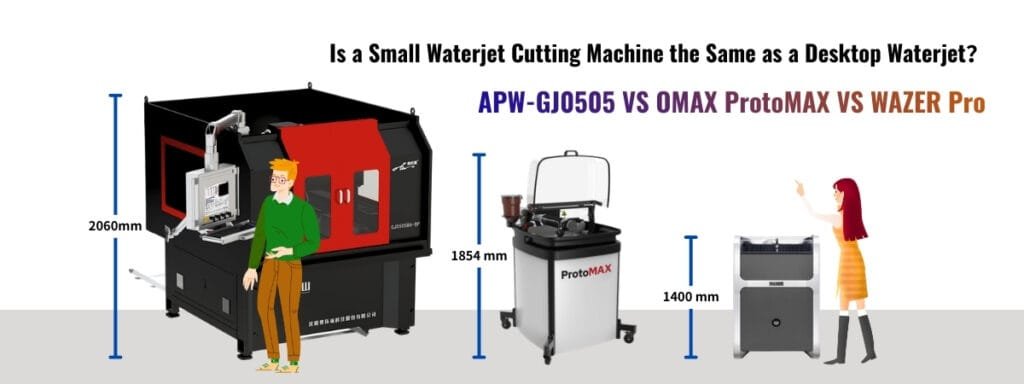
Is a small waterjet cutting machine the same as a desktop waterjet?
To answer this question, we will compare three widely discussed machines on the market:
- OMAX ProtoMAX
- WAZER Pro
- APW-A22S-GJ0505-DXACWZ
This comparison will help you understand their differences and choose the right machine for your application.
Small Waterjet Cutting Machine Overview and Specifications
Different Manufacturers and Market Positioning
Although the three machines are often grouped into the same category of small waterjet cutting machines, they are produced by manufacturers with very different backgrounds and target markets.
OMAX ProtoMAX
ProtoMAX is produced by OMAX, a well-known manufacturer of industrial abrasive waterjet systems.
The ProtoMAX system was developed primarily for:
- education
- training labs
- research institutions
It focuses on ease of use and software integration, rather than maximum cutting power.
WAZER Pro
WAZER Pro was developed by a startup company focused on bringing waterjet technology to makers and small workshops.
Its main design goals include:
- simplified operation
- compact footprint
- affordable access to waterjet cutting
As a result, WAZER Pro is popular in makerspaces and small creative workshops.
APW-GJ0505
The APW-A22S-GJ0505-DXACWZ is developed by APW, a manufacturer specializing in industrial waterjet systems.
Unlike many desktop-focused products, the APW machine is designed to bring industrial-level cutting capability into a compact format, making it suitable for:
- industrial laboratories
- materials research facilities
- precision manufacturing environments
Technical Specifications of the Small Waterjet Cutting Machine
Below are the key specifications of the three machines.
| Parameter | APW-GJ0505 | ProtoMAX | WAZER Pro |
| Cutting Area | 500 × 500 mm | 304 × 304 mm | 305 × 460 mm |
| Z-Axis Travel | 0–150 mm adjustable | 25 mm fixed | Fixed |
| Axis System | AC 5-axis | 3-axis | 3-axis |
| Maximum Pressure | 360–413 MPa (3600–4130 bar) | 206.8 MPa (2068 bar) | 59.3 MPa (593 bar) |
| Pump Power | 23.9–75 kW | 3.7 kW | 2.1 kW |
| Structure | Separate modules | Integrated | Integrated |
| Control System | Industrial CNC + CAM | OMAX Intelli-MAX | WAM + SD card |
Key Performance Comparison
Several technical indicators reveal significant differences between these machines.
Pressure
Pressure is one of the most critical parameters in a small waterjet cutting machine.
Higher pressure provides:
- stronger cutting capability
- faster cutting speeds
- improved performance on hard metals
For example:
| Machine | Maximum Pressure |
| APW-A22S | 413 MPa (4130 bar) |
| ProtoMAX | 206.8 MPa (2068 bar) |
| WAZER Pro | 59.3 MPa (593 bar) |
Low-pressure systems such as WAZER Pro are generally limited to thin sheets and softer metals.
Z-Axis Flexibility
Another important difference is the Z-axis capability.
| Machine | Z-Axis Travel |
| APW-GJ0505 | 0–150 mm adjustable |
| ProtoMAX | 25 mm fixed |
| WAZER Pro | Fixed height |
A larger Z-axis range allows:
- thicker materials
- fixtures and jigs
- more complex workpieces
Unique Advantages of Each Small Waterjet Cutting Machine
ProtoMAX Advantages
ProtoMAX is known for its mature software ecosystem.
The OMAX Intelli-MAX control system provides:
- CAD/CAM integration
- cutting simulation
- automatic toolpath optimization
This makes ProtoMAX very suitable for education and training environments.
WAZER Pro Advantages
The biggest advantage of WAZER Pro is simplicity.
Its workflow typically follows these steps:
- Design parts on a computer
- Export DXF or SVG
- Transfer files via SD card
- Run the cutting program
This simplified workflow works well in makerspaces and small workshops.
APW-GJ0505 Advantages
The APW system provides several industrial-grade capabilities rarely seen in compact machines:
- AC five-axis cutting head
- up to 413 MPa pressure
- 150 mm adjustable Z-axis
- industrial CNC control system
These features enable:
- bevel cutting
- taper compensation
- complex geometry machining
Choosing the Right Small Waterjet Cutting Machine for Your Application
Different application environments require different types of machines.
If you run an educational lab
ProtoMAX is a good choice.
Reasons include:
- mature software
- reliable operation
- safe learning environment
If you operate a makerspace or creative studio
WAZER Pro may be suitable.
Reasons include:
- simple workflow
- compact design
- relatively low entry barrier
If you work in an industrial or materials research laboratory
APW-GJ0505 is usually the better option.
Reasons include:
- higher cutting pressure
- five-axis capability
- adjustable Z-axis
- stronger machining flexibility
These features are particularly useful for:
- alloy sample preparation
- cross-section cutting
- material structure analysis
Learn More About Small Waterjet Cutting Machines
Choosing the right small waterjet cutting machine depends on your application requirements, workspace, and processing materials.
If you would like to learn more about APW waterjet systems, including:
- five-axis cutting solutions
- laboratory waterjet systems
- industrial abrasive waterjet machines
please contact our sales team for more information or a technical consultation.
FAQ
Technical FAQ
What materials can a small waterjet cutting machine cut?
A small abrasive waterjet cutting machine can cut a wide range of materials without generating heat-affected zones. Common materials include:
- Aluminum
- Stainless steel
- Carbon steel
- Copper and brass
- Glass
- Ceramic tiles
- Stone
- Engineering plastics
- Composite materials
Because waterjet cutting is a cold cutting process, it is particularly suitable for materials that are sensitive to heat deformation.
What is the typical cutting thickness for a small waterjet machine?
Cutting thickness depends on several factors, including:
- Pump pressure
- Orifice size
- Abrasive flow rate
- Material hardness
Small waterjet systems with 380 MPa (≈3800 bar) high-pressure pumps are typically used for:
- Thin metal plates
- Medium-hard alloys
- Laboratory material samples
For thicker industrial cutting, larger waterjet systems with higher power pumps are usually required.
Why is high pressure important for waterjet cutting?
Higher pressure directly increases the kinetic energy of the waterjet, which improves cutting capability.
Benefits of higher pressure include:
- Faster cutting speed
- Ability to cut harder materials
- Better cutting stability
- Improved efficiency in abrasive waterjet systems
In applications involving metal cutting or alloy material testing, high pressure is often a critical requirement.
Why do some waterjet machines use a 5-axis cutting head?
A 5-axis waterjet cutting head allows the nozzle to tilt and rotate during cutting.
Typical axis movement includes:
- A axis: ±75° tilt
- C axis: ±360° continuous rotation
This configuration allows the machine to:
- Compensate for taper in thick materials
- Perform beveled cutting
- Cut complex 3D geometries
- Improve edge quality
Five-axis systems are commonly used in industrial laboratories and advanced manufacturing environments.
What kind of workspace is needed for a compact waterjet machine?
Compact waterjet systems are designed to reduce installation requirements compared with large industrial machines.
However, users should still prepare:
- A stable power supply
- Water supply and filtration
- Abrasive storage and handling
- Wastewater management
A machine with a 500 mm × 500 mm cutting platform can often fit into:
- laboratories
- small workshops
- research facilities
- prototyping environments
Application FAQ
I work in a materials or industrial laboratory. Can a small waterjet machine be used for alloy sample testing?
Yes. Many industrial laboratories and materials research labs use compact waterjet systems for:
- alloy sample preparation
- cross-section cutting
- metallographic analysis
- prototype component testing
Because waterjet cutting does not generate thermal distortion, it is especially suitable for preparing samples where material integrity must be preserved.
In these environments, high pressure and 5-axis capability are often essential requirements.
We manufacture small metal components and prototypes. Is a compact waterjet suitable for our workshop?
For workshops producing small metal parts or prototypes, a compact waterjet machine can be a flexible cutting solution.
It can be used for:
- prototype development
- short-run production
- complex contour cutting
- multi-material fabrication
Compared with traditional machining, waterjet cutting offers the advantage of cutting many materials without changing tools.
Can a small waterjet machine be used in educational institutions or research centers?
Yes. Many universities, engineering schools, and research institutes use compact waterjet machines for:
- engineering education
- materials science research
- mechanical design experiments
- rapid prototyping projects
The technology allows students and researchers to explore advanced manufacturing processes while working with real industrial equipment.
I’m a DIY enthusiast interested in making custom metal or glass projects. Can a small waterjet machine be used for hobby work?
Waterjet cutting can process many materials commonly used in DIY projects, including:
- aluminum
- stainless steel
- glass
- tile
- plastics
However, hobby users should carefully consider:
- installation requirements
- abrasive handling
- water management
- operating safety
Compact systems with smaller footprints may be more suitable for personal workshops or creative studios.
I am a distributor or equipment dealer. Is there a growing market for small waterjet cutting machines?
Yes. In recent years, compact waterjet machines have expanded beyond traditional heavy industry into new markets such as:
- maker spaces
- creative fabrication studios
- university laboratories
- research institutes
- small manufacturing workshops
For distributors, key factors often include:
- product reliability
- technical support and training
- application flexibility
- differentiation from laser or plasma cutting systems
Machines that combine industrial cutting capability with compact size may offer strong potential in these emerging segments.