1. Common Quality Issues and Causes in Round Bar Cutting
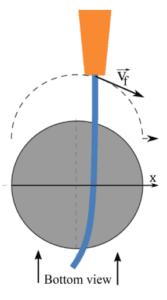
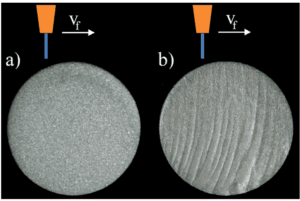
In actual waterjet metal cutting of round bars, the same issues tend to show up repeatedly: taper on the cut surface (wider at the top, narrower at the bottom), inconsistent striation patterns, rough surfaces in the center area, and sometimes overcutting near the edges.
These are usually not equipment problems, but process mismatch. Round bar is different from flat plate. The thickness is always changing — edge is thin, center is thick. If use one same cutting parameter for whole path, usually you will see edge already cut through, but center still not enough.
Also, standoff distance is something many people don’t really check. If Z-axis is fixed and not following the surface, the distance between nozzle and material will keep changing.
Toward the center, that gap gets bigger, the jet starts to lose focus in the air, and the cutting performance drops off.
2. Process Strategy Based on These Causes
2.1 Maintain a Constant Optimal Standoff Distance
Standoff distance is simply the gap between the nozzle and the material surface. In most cases, around 3 mm provides stable cutting performance.
If the distance is too large, the jet loses focus before reaching the material, reducing cutting efficiency. If it is too small, splash back and instability can occur.
With round bars, a fixed Z position means the standoff is only correct at one point. Moving toward the center, the distance increases naturally, which changes the cutting condition.
Better way is to let Z-axis follow the bar surface, not keep it fixed. By using 3D or 5-axis programming, the nozzle distance to material can stay almost same during cutting. When this distance is stable, cutting quality will be more consistent, especially in the middle area.
2.2 Zone-Based Speed Control
After standoff is controlled, next step is to adjust cutting speed.
Because thickness is not same in whole cutting path, using one constant speed is not suitable. If keep same speed, edge will cut too fast, but center part may not cut fully.
In actual operation, it’s more practical to split the path into a few sections — edge, transition, and center — and adjust the speed step by step instead of keeping it constant.
| Zone | Thickness Condition | Recommended Speed (relative to center) |
| Edge Zone | Thinnest | 100% |
| Transition Zone | Medium | 70%–80% |
| Center Zone | Thickest | 50%–60% |
One important point: the “100% speed” is not a fixed number — it represents the maximum cutting speed your system can achieve for that material.
This capability is mainly determined by pump pressure. Higher pressure means higher jet energy and higher achievable cutting speed. Before setting the speed ratios, it is recommended to refer to a cutting speed chart for different pump configurations and materials to define a proper baseline.
With this approach, the edge is cut efficiently without overprocessing, while the center gets enough time and energy for a clean cut, resulting in a more uniform surface.
2.3 Tip: Nozzle and Abrasive Selection
If the above adjustments are already in place but further improvement in surface uniformity is needed, some fine-tuning can be done on the nozzle and abrasive.
A smaller orifice generally produces a more focused jet and more uniform striations. Using slightly finer abrasive or reducing abrasive flow can also help stabilize the jet and reduce nozzle wear.
That said, this is a secondary adjustment. If standoff and speed are not properly controlled, changing the nozzle alone will not solve the problem.
3. Integrated Optimization Approach
In practice, the process does not need to be complicated. A straightforward approach works well:
First, enable Z-axis compensation to maintain a stable standoff distance;
Then divide the cutting path based on bar diameter and adjust speed by zones;
Reduce speed in the center area to control jet lag and roughness;
Finally, if higher surface quality is required, optimize nozzle and abrasive parameters.
The key idea is not optimizing a single parameter, but matching process parameters to geometry changes. Once this is aligned, both cutting quality and efficiency can be improved.