1. Manual Purpose
This manual makes standard rules for ultra-high pressure waterjet cutting process performance check, variable test, quality inspection and parameter setting whole process. Solve problems like can’t cut through, big taper, bad surface roughness, ripple, edge break, low efficiency, unstable parameters. Achieve standard process optimization, make mass production more stable.
Suitable Equipment: Ultra-high pressure abrasive waterjet cutting machine / 5-axis waterjet machine
2. Four Big Bad Cutting Problems (Optimization Goals)
All optimization, check and test work around these four problems:
- Efficiency Problem: Slow moving speed, can’t cut through, low output (low MRR material remove rate)
- Size Accuracy Problem: Cut mouth taper, top and bottom width different, size error
- Surface Quality Problem: Rough surface, ripple, scratch, small hole, edge break
- Stability Problem: Big difference in same batch, sometimes cut through, sometimes not
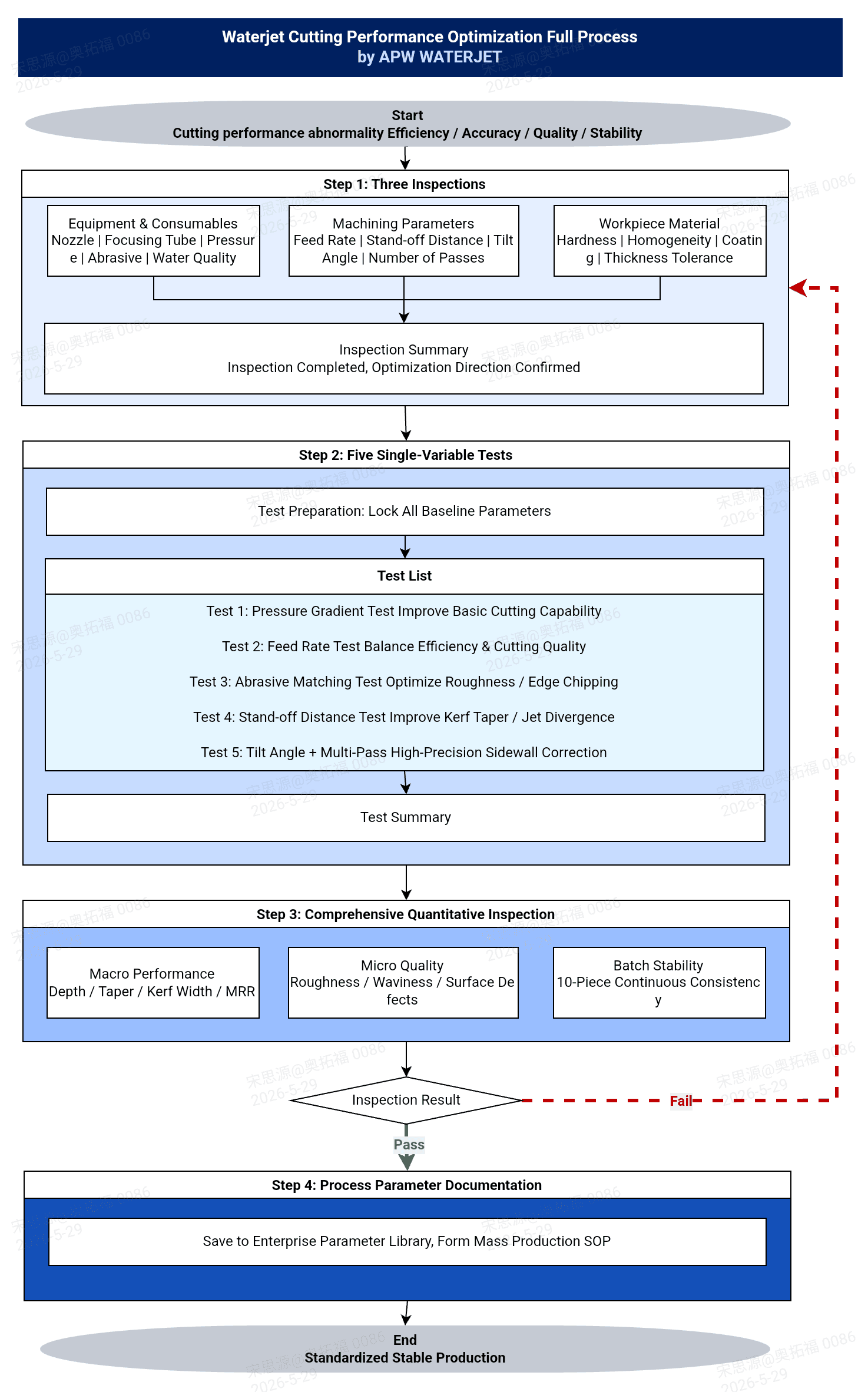
3. Step One: Cutting Performance Abnormal【Standard Check Flow】
Follow order: first equipment and wearing parts → then process parameters → last workpiece material (90% problems from first two parts)
3.1 Equipment & Wearing Parts Check (Check First, Easy to Ignore)
Wearing parts worn out is the first reason for bad cutting
- Gem Nozzle Orifices: Check hole become big, off center, scratch, turn white; after worn, water jet spread, directly cause taper and can’t cut through
- Focus Pipe Focusing Tube: Check inner wall worn, horn mouth, off center; focus pipe worn cause abrasive mix not even, big ripple
- High Pressure Stability Pressure: No load / work pressure swing within ±5MPa or not; pressure shake cause cutting depth different
- Abrasive Sand Abrasive: Wet, lump, mix different size, flow not stable; sand stop or flow up and down cause stripe and can’t cut through
- Water Quality & Additive Additives: Water dirty, much scale, no anti-rust lubricant, cause water jet not stable, wearing parts life short
3.2 Processing Parameter Check (Process Problem)
- Move Speed Feed Rate: Too fast → can’t cut through, big ripple; too slow → cut too deep, edge fall down
- Nozzle-Work Distance Stand off distance: Standard 1–3mm; too big → water jet spread, cut mouth wide, taper big
- Tilt Angle Tilt Angle: Thick plate no taper fix → side wall slant; angle too big/small → reverse taper
- Cut Times Number of Treatments: Thick plate/high precision material one time cut not enough accuracy
3.3 Workpiece Material Check (Material Problem)
- Material hard/density not even → cutting resistance change
- Compound material, middle layer, coat easy edge break, layer split
- Material thickness difference big → nozzle-work distance not stable
4. Step Two: Performance Optimization【Standard Test Flow (Single Variable Test)】
Core rule: change one thing only, fix all other parameters, then find best process exactly
4.1 Fix Base Parameter Before Test
Lock all before test: nozzle type, focus pipe type, sand size, water quality, material batch, room temperature, machine base pressure
4.2 Five Big Key Variable Test Order (From Important to Less)
Test 1: Pressure Optimization Test (Base Cut Ability)
- Fix: move speed, nozzle-work distance, sand flow, cut times
- Change: pressure ±20MPa step test
- Check target: cut deep ability, cut mouth even, ripple change
Test 2: Move Speed Optimization Test (Efficiency/Quality Balance)
- Fix: pressure, nozzle-work distance, sand
- Change: 50–200mm/min step test
- Check target: fastest cut through speed, rough change, ripple limit
Test 3: Sand Flow/Size Test (Surface Quality Key)
- Change: big sand (fast cut)/small sand (smooth), more/less sand
- Check target: rough, edge break, stripe, cut stable
Test 4: Nozzle-Work Distance Step Test (Taper Key)
- Change: 1mm / 2mm / 3mm / 4mm step
- Check target: cut mouth width, top-bottom taper, water jet focus
Test 5: Tilt Angle + Multi-Cut Test (High Precision Final Fix)
- Change: fix angle small change, 1 time/2 times/3 times cut
- Check target: side wall straight, size accuracy, small rough
5. Step Three: Cutting Performance【Standard Check Item】
After all test, must check these index, get number data, not just look with eyes
5.1 Big View Cutting Performance Check
- Cut Mouth Width Kerf Width: Top-bottom width difference → judge taper
- Cut Depth Depth of Cut: judge max cut through ability
- Cut Mouth Taper Kerf Taper: thick plate precision key index
- Material Remove Rate MRR: judge cut efficiency high or low
5.2 Small View Quality Check
- Surface Roughness Ra: high level part must check number
- Surface Ripple Wt: waterjet special ripple bad point
- Edge Break, Layer Split, Heat Hurt Check: compound/coat part must check
5.3 Stability Check (Mass Production Must Do)
Cut 10 pieces one after one, check size change, surface same or not → judge parameter can mass produce or not
6. Step Four: Data Record & Process Fix (Make Company Standard)
Every optimization must write down these, finally make 《Material-Thickness-Parameter Standard List》
- Material name, thickness, hard, batch
- Nozzle type, focus pipe type
- Cut pressure, sand size/flow
- Move speed, nozzle-work distance, tilt angle, cut times
- Check result: taper, rough, MRR, good part status
- Final judge: best mass produce parameter
7. Fast Fault Optimization Check Table (Use On Site Directly)
| Bad Problem | First Check Factor | Optimization Test Way |
| Can’t cut through, bottom mark | Pressure low, move too fast, sand too small | Raise pressure, slow down, more sand flow, check wearing parts worn |
| Cut mouth top wide bottom narrow (big taper) | Nozzle-work distance too big, no angle fix, focus pipe worn | Shorten distance, open taper fix, small change tilt angle, change focus pipe |
| Surface big ripple | Move too fast, sand not even, pressure shake | Slow down move, change new sand, stable pressure, small change multi-cut |
| Edge break, corner fall, layer split | Nozzle-work distance wrong, one time cut, material easy break | Slow down a little, multi-cut, small sand, fix nozzle-work distance |
| Low efficiency | Pressure too low, move too slow, sand too small | Step up move, use big sand, pressure test |
8. Whole Close Flow Summary
Check wearing parts & machine stable first → single variable step test → big view + small view number check → batch stable check → fix standard process parameter
This flow cover all fishbone chart reason, can use directly as company waterjet process optimization SOP
Appendix 1 – Professional Terms and Explanations in the Document
| Type | Factor | Simple Explain | Process Use & Key Function |
| 1. Process Parameter (Water Jet Energy Core) | Orifices | Key part make water jet, use sapphire/ruby hard material, only way high pressure water go from machine to air. Key control: hole size, length, material | 1. Decide water jet start flow, pressure and focus, base of cut ability; 2. Small hole nozzle for precision cut, better accuracy, narrow cut mouth; 3. Big hole nozzle for thick plate/more water cut, faster remove material |
| Focusing Tube | Install under nozzle, mix high pressure water and sand well, focus jet. Key control: inner size, length, inside shape, material | 1. Decide final water jet focus, energy big or small, cut stable; 2. Long focus pipe better focus, for deep hole/thick plate cut, same deep all time; 3. Short focus pipe fast move, for complex shape/special part cut, less error when change path | |
| Pressure [MPa] | High pressure water key power, pressure from pump, normal work 100–400MPa | 1. Decide cut ability: higher pressure cut thicker/harder material, faster remove material; 2. Low pressure (100–200MPa): soft material/thin plate/precision cut, no heat hurt, fine work; 3. High pressure (300–400MPa): thick metal/stone/compound material, heavy cut key parameter | |
| Abrasive | Hard grain mix in high pressure water, fast hit remove material. Key control: type, size, flow | 1. Sand is key for hard material cut, no sand water only cut soft material; 2. Big size sand (small number) for thick/hard material, faster cut; 3. Small size sand (big number) for precision cut/smooth surface, less rough; 4. Sand flow decide speed and cost, balance fast cut and less sand use | |
| Additives | Chemical liquid mix in water. Key control: type, density | 1. Make water jet better, cut good, protect machine parts; 2. Common: anti-rust oil (protect pipe/nozzle/focus pipe), lubricant (less water resistance, better focus), anti-foam (stable water jet); 3. Use right, wearing parts longer life, cut stable, less machine bad | |
| 2. Process Parameter (Cut Work Way) | Feed Rate [mm/min] | Cut head move speed along part shape, balance fast and good | 1. Directly decide speed: faster move, cut more length, more output; 2. Big effect on quality: too fast → can’t cut through, big taper, bad surface; too slow → cut too deep, low speed; 3. Match speed with material thick/hard/pressure, key change on site |
| Nozzle-Work Distance – Stand off distance [mm] | Space between nozzle bottom and part top, key for water jet power | 1. Decide water jet power when hit part: shorter distance, less power lose, stronger cut, better accuracy; 2. Normal best 1–3mm, fit most cut; 3. Too big → water jet spread, weak cut, wide mouth, big taper; 4. Complex shape change distance, same cut all shape | |
| Cutting Head Tilt Angle | Cut head slant angle, fix taper, better accuracy | 1. Key use: fix water jet taper (top wide bottom narrow), slant head make side wall straight, better size; 2. Good for thick plate, less taper, no need second work; 3. Complex shape change angle, same accuracy all path | |
| Cut Times – Number of Treatments | Cut same line many times, one time or many times | 1. One time cut: thin plate/soft material/fast work, fast cut, less sand cost; 2. Many times cut: thick plate/hard material/high precision, cut deep step by step, fix taper, smooth surface; 3. 2–3 times cut fast and good, super thick/high precision cut more times | |
| 3. Workpiece Parameter (Cut Hard Level) | Part Shape – Workpiece Geometry | Part outline, size, thick, hole and other shape | 1. Decide path plan hard or easy, match parameter; 2. Straight/simple shape: fast move, one time cut, fast work; 3. Complex/small hole/deep hole: slow move, many times cut, change distance/angle, good accuracy first; 4. Thickness key control, directly decide pressure/sand flow/move speed |
| Part Special Feature (Coat etc.) – Workpiece Peculiar characteristics (surface coatings…) | Part surface coat, plate, rust layer, middle layer, special property | 1. Coat/plate change cut hard, change parameter: – Hard coat (ceramic/diamond): higher pressure, slow move, more sand; – Easy fall coat: short distance, one time cut, no edge break; 2. Easy burn/easy rust part: water only cut, gas protect, special process | |
| Material Even – Material Homogeneity | Part inside same or not, same material or different | 1. Same material (normal metal/glass): cut stable, easy parameter, mass produce same set; 2. Different material (compound/honeycomb/stone): inside hard different, resistance change, change move/pressure, no can’t cut/cut too deep/layer split; 3. More different, harder cut, need change parameter more | |
| Material Density – Material Density [kg/m³] | Heavy per size, material tight level | 1. Directly decide cut hard: heavier material, tighter, need more power, higher pressure/more sand/slow move; 2. Light material (foam/rubber/wood): low pressure water cut, fast move, fast work; 3. Heavy material (stainless steel/titanium/granite): high pressure sand cut, right speed, fast and good | |
| Material Hardness | Material not easy change shape/cut, use HRC/HB/Mohs | 1. Key decide cut hard: harder material, harder cut, need more water power/sand hit; 2. Soft material (aluminum/copper/plastic): low pressure, less sand, fast move; 3. Hard material (hard steel/titanium/sapphire): high pressure, more sand, slow move, many times cut; 4. Super hard (>HRC60): need 300MPa+ high pressure machine, special sand | |
| Material Elastic Modulus [MPa] | Material easy bend or not, hard/soft | 1. Big effect on cut shape and mouth quality: – Hard material (metal/glass/stone): not easy bend, cut good, easy parameter; – Soft material (rubber/foam/thin metal): easy bend/shake, bad mouth/rough; slow move, short distance, many times cut, no bend | |
| Material Type/Structure – Material Tipology | Material kind, inside shape, like metal, no metal, compound, hole, honeycomb | 1. Decide cut way and parameter, first step for process plan; 2. Metal: sand water cut, balance pressure/sand/move speed; 3. Soft no metal: water only cut, no heat hurt, fit food/medical/seal part; 4. Compound/hole material: change parameter, no layer split/edge break/shape bad |
Thanks a lot to Professor Massimiliano Annoni from the Department of Mechanical Engineering, Politecnico di Milano, for his excellent article. Also thanks to the after-sales engineers at APW Waterjet for their guidance based on many years of practical experience.
If you are interested in waterjet cutting technology, you can consult our experienced sales team. You can also visit our YouTube channel to watch cutting videos more directly. To download the high-resolution operation flow chart, please click here.